
Court finds Circle C Construction, LLC, liable for falsifying certifications, but remands for further proceedings to determine damages

The United States Court of Appeals for the Sixth Circuit has affirmed a District Court ruling holding Circle C Construction, LLC, liable under the False Claims Act for submitting false payroll certifications, while remanding the case for further determinations about damages.  Circle C’s contract –for construction work at a Kentucky military installation –explicitly incorporated the certification requirements of the Davis-Bacon Act, 40 U.S.C. § 3142 wage and hour law specifying wage determinations for electrical workers.  Circle C, a contractor with 20 years of experience in government contracts, conceded its knowledge of various Davis-Bacon requirement and stated that one of its co-owners and its bookkeeper attended a training session at the Fort Campbell installation on the prevailing wage requirement for federal government contracts.  Despite its knowledge of these requirements, Circle C did not include the employees of its primary electrical work subcontractors, Phase Tech, on its original certifications, nor did it verify that these workers were paid prevailing wages.  All Phase Tech electrical workers and laborers were paid at least two dollars an hour less than prevailing wages.

The Sixth Circuit found that Circle C’s payroll certifications were expressly false because:

  • they stated that they were complete, when in fact no Phase Tech employees who worked on the project were listed, and
  • they falsely represented that the prevailing wages were paid to subcontracted employees.

The Sixth Circuit overturned the damages award because the estimation of cost to the government by the Supervisory Contract Specialist at the Directorate of Contracting at the Fort Campbell Army Post:

  • lacked specific detail,
  • included projects outside the scope of the amended complaint (in Tennessee instead of Kentucky),
  • did not adequately account for the discrepancies in the relevant sums presented by the parties, and
  • did not accurately represent the difference between what the government paid to Circle C, what Circle C paid to Phase Tech, and the payments to which Circle C would have been entitled in the absence of its fraud.

This reversal and remand for further proceedings on damages indicates that an activity by activity accounting, instead of a general estimated amount based on percentages, might be necessary to effectively calculate damages under the express certification theory.
“Backing Barack”

The US President wins some heavyweight economic support as Reuben Guttman sees the curtain rise on the International Bar Association’s annual gathering in Dublin, Ireland.  See Reuben Guttman’s October 1, 2012 blog in The European Lawyer.

The International Bar Association opened its annual convention with keynote speaker and Nobel Prize winning economics professor Joseph Stiglitz announcing his support for the re-election of US President Barack Obama.

Speaking before several thousand attorneys from across the globe, Prof Stieglitz called for additional regulation of the banking and financial services sectors. ‘The first fiscal stimulus worked but it was too small,’ he told delegates. ‘We need another; we cannot afford not to do another stimulus.’

No choice

Prof Stiglitz’s support for Obama came as a surprise response to a question from a British lawyer. ‘Clearly Obama is better,’ he said. ‘When compared to the alternative there is no choice.’ But Prof Stiglitz also said that Mr Obama could have done ‘more with the restructuring of home mortgages’.
The Nobel Prize winner went on to compare the conduct of the banks to gambling, which is why ‘regulation is so important’.
A recent New York Times comment article — co-authored by Prof Stiglitz and economist Mark Zandi — noted that the president’s housing policies have ‘fallen short’ but that ‘Mitt Romney hasn’t offered any meaningful new proposals to aid distressed or underwater homeowners’.
Here in Dublin, when pressed, he made his ultimate political choice clear.

Political gridlock

While Prof Stiglitz urged more regulation, he expressed concern that political gridlock may preclude timely government intervention. ‘People say they believe in free markets but one person’s freedom is the right not to be injured by others,’ said Prof Stiglitz.

He continued by commenting that the ‘disparity in income brought about by the economic crisis means that there will be a disparity in political clout’. And he urged IBA members to respond by making sure that there will always be access to justice for those without the economic means.

It was a particularly intriguing observation given the controversy caused by the US Supreme Court’s 2010 ruling in Citizens United v Federal Elections Commission, which expanded the rights of corporations to make independent expenditures to influence the outcome of federal elections. The 2012 election marks the first test of that judgment on a US presidential race.

http://www.globallegalpost.com/blogs/commentary/backing-barack-91190962/

Expanded Protection for Whistleblowers: California Amends its False Claims Act

On August 16, 2012, the California Assembly passed a bill (AB 2492) amending California’s state False Claims Act, Cal. Gov’t Code §§ 12650-12656 (“CAL FCA”) to largely conform to the provisions of the federal False Claims Act (“FCA”).  According to the Deficit Reduction Act of 2005, states with FCAs “at least as effective” as the federal FCA qualify for an additional 10 percent of any recoveries related to false Medicaid claims.  Due to the recent changes in the federal FCA as a result of the Fraud Enforcement and Recovery Act of 2009 (“FERA”), the Patient Protection and Affordable Care Act (“ACA”), and the Dodd-Frank Wall Street Reform and Consumer Protection Act (“Dodd-Frank Act”), states which seek to qualify for the additional payments must be proactive in ensuring that their FCAs are “at least as effective” as the federal FCA by the March 31, 2013 deadline.

The proposed amendments to the CAL FCA would expand both the liability of defendants and the rights of qui tam plaintiffs in a number of ways, including broadening the definition of “original source” and increasing protections for whistleblowers.  .

Some of the key amendments include:

  • Allowing the Attorney General to override the public disclosure bar.  The CAL FCA would permit the California Attorney General (“AG”) to prevent dismissal of a CAL FCA claim based on publicly disclosed information by “opposing” dismissal.
  • Expanding the definition of “original source.”  The CAL FCA definition would broaden to include individuals who have voluntarily disclosed to the state the information upon which a claim is based, or have knowledge that is independent of, and “materially adds” to, publicly disclosed allegations of false claims.
  • Broadening the definition of “claim” to include “contractor, grantee, or other recipient, if the money, property, or service is to be spent or used on a state or any political subdivision’s behalf or to advance a state or political subdivision’s program or interest . . . .”;
  • Incorporating the federal FCA’s definition of an “obligation”: An obligation includes retention of an overpayment, thereby giving rise to liability under the CAL FCA for retention of an overpayment;
  • Statute of limitations/relation back:  The CAL FCA would provide that, for statute of limitations purposes, if the AG files a complaint in intervention, it will relate back to the filing date of the relator’s complaint;
  • Making relators eligible for an award even if they planned and initiated the violation upon which the CAL FCA action was based; 
  • Eliminating the requirement that a claim must have been presented to an officer, employee, or agent of the state;
  • Clarifying that the CAL FCA’s anti-retaliation provisions apply when relators are discriminated against for furthering an action under the CAL FCA or for trying to stop a violation of the CAL FCA;
  • Granting relief to relators who are discriminated against, including reinstatement with the same seniority status, twice the amount of back pay plus interest, and compensation for special damages.
  • Defendant can recover attorneys’ fees:  clarifying an existing provision allowing defendants to recover attorneys’ fees if the defendant prevails in a CAL FCA case and the court finds that the claim was clearly frivolous, clearly vexatious, or brought primarily for purposes of harassment.

Comprehensive Conference on Litigation Class Actions

December 6 & 7, 2012 | Chicago, IL

This conference is designed to provide a cutting-edge and in-depth exploration of this vibrant area of the law. Our faculty is comprised of leading class action practitioners, judges and service providers from across the United States who will discuss strategies from both plaintiffs’ and defendants’ perspectives. This two-day conference will include discussions of the latest developments in significant areas of the law affected by class action practice, including recent decisions concerning antitrust, arbitration rights, damages calculations, forum issues, securities and other financial transactions, consumer protection, contracts, false claims act/whistleblower claims, governmental investigations, labor and employment, and Internet privacy, to name just a few.

To Learn More visit Law Seminars International.

Changing the Debate

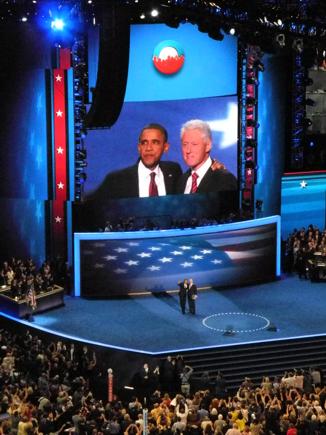
CHARLOTTE, NC — Twenty-eight years ago, then New York Governor Mario Cuomo gave a keynote address to the Democratic National Convention in San Francisco with a speech that will be remembered for the ages. But that speech, which focused on the demise of an industrial economy, was built on passion and emotion.

Last night, Former President Bill Clinton gave a speech to delegates that will be remembered for the ages, but for different reasons. It was a speech based on facts and logic. It was a speech which established protocols for how voters should think about the issues. It was also a tactical speech that counseled voters on how they should evaluate the Romney message which will be delivered not door-to-door but over the airwaves. It was Bill Clinton at his best; he didn’t just speak — he taught.

For those seeking to make an argument in an era of hyperbole, the Clinton speech — indeed perhaps a closing argument — is a lesson in how to organize facts and raise questions. It is a lesson for whistleblowers – a lesson for those who are sometimes caught up by emotion and argue passion rather than logic.

1 16 17 18 19 20 45