The American presidential spectacle

Prominent US trial lawyer Reuben Guttman shares his thoughts on the spectacle that is the US presidential election.

Every four years, the world is treated to the spectacle of the Summer Olympics, where athletes run their legs in a show of skill and strength. Coinciding with this occurrence is the American presidential election, where candidates run their mouths.

The Republicans have enough candidates to stage two debates. Those candidates with lower poll ratings are relegated to sitting at what amounts to the children’s table, where – naturally – the debate starts earlier. Presumably this is so the children can be tucked in while the front runners do their business.

The Democrats only have three major candidates and are having a go at it without any children this time around.

Though hard to discern, there are strategies to these matches of American intellect. Just as an Olympic distance runner saves his or her strength for the final lap, US presidential candidates try not to burn any intellectual reserve this early in the game. Standing behind their podiums, they take notes, adjust their glasses, and give each other gimlet eye glances. The winner is the one who says the least while maintaining the optics of communicating the most.

The Republicans thrive on debating who is a real conservative, who is more electable, and who has more guns.

For their part, the Democratic debate is just as vacuous; is Bernie Sanders a socialist and what extracurricular activities are on the agenda of Hillary’s husband, the former president? The third candidate, Martin O’Malley, seems to get lost in the mix. No surprise there; when he was governor of Maryland, most Marylanders only knew that he was the governor because signs on the highways said so. Sadly, those without an automobile were left clueless.

If Martians were to invade and randomly channel surf, they might actually confuse the debates with a reality TV show. Come to think of it, the Martians would be right.

All of this is unfortunate. There are real issues. The next president will have the ability to make appointments tipping the balance of the judiciary including the Supreme Court. Obamacare is still a work in progress and the next president needs to do something about the Centers for Medicare Services, which in privatising the Medicare system allows more theft than would be sustained by an electronics store with a plate glass window during a lengthy power outage.  There is also much to discuss on the foreign policy front, including a massive trade imbalance and regulation of publicly traded companies in a global economy.

But for now, why talk specifics when we, Americans, are still tuning in to watch the spectacle?

Reuben Guttman is a trial lawyer and founding partner at Washington, DC-based firm Guttman, Buschner & Brooks.

VIDEO: Getting Started as a Whistleblower

People who think they’re witnessing corporate fraud undoubtedly have many questions and concerns. This video will help answer some of those initial questions, and you can easily and confidentially contact us if you believe you’ve witnessed fraud.

You’ll find information on the different types of fraud that we work with, including securities fraud, pharmaceutical fraud, medicare/medicaid fraud, defense contractor fraud, fraudulent loans and grants, and finally, federal government contractor fraud.

You can learn about the Federal and State False Claims Act, and can also read the laws.

We’ll provide you with insight into what it means to be a whistleblower. In the Getting Started section, we provide information on what the experience is like, what to do if you think you’ve witnessed corporate misconduct, how to select a whistleblower law firm, and what the process is like as you work with your whistleblower attorneys.

Finally, visit us often for information through a variety of resources in the form of News, Articles, and Frequently Asked Questions. Reuben Guttman, co-founder of Guttman Buschner, PLLC, authors an active Blog with insight into current cases and laws.

Do you think you've witnessed fraud in your company?

CALL NOW TO TALK TO A WHISTLEBLOWER ATTORNEY

(202) 800-3001

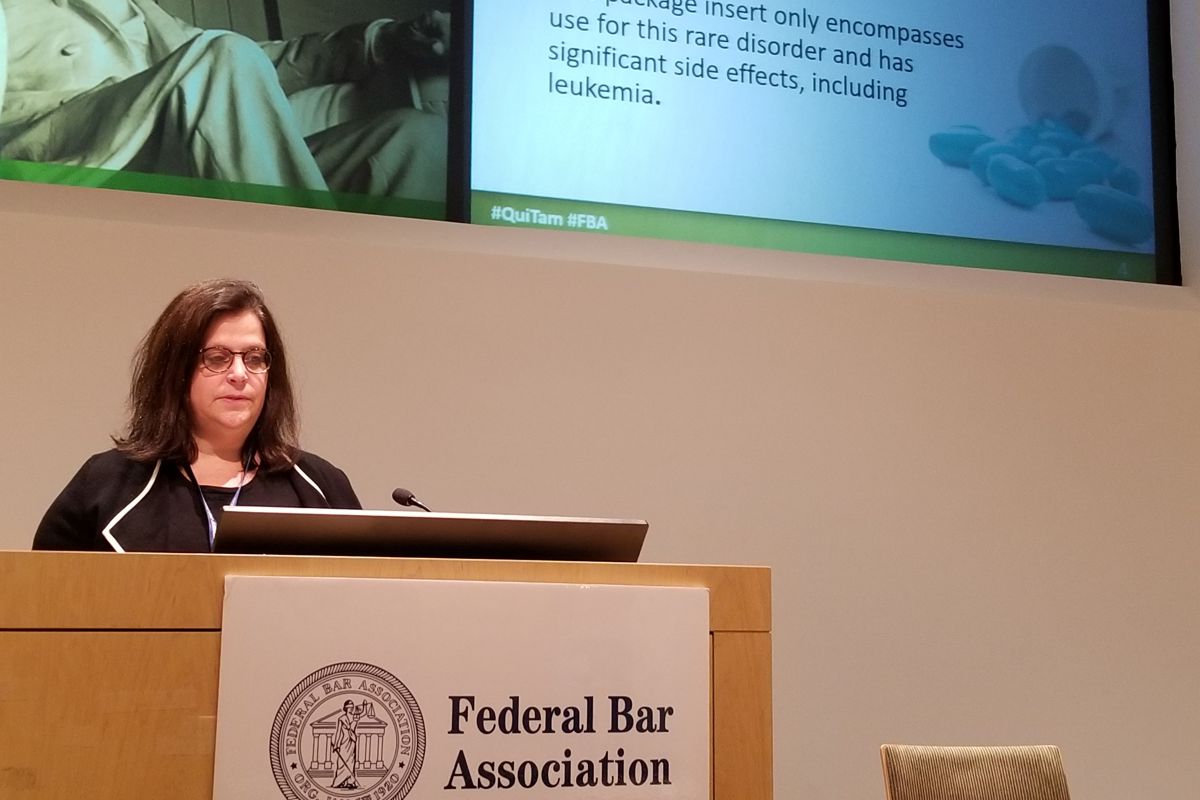
LEADING: Partner Traci Buschner to moderate Ethics panel at the FBA Qui Tam Conference.

At vero eos et accusamus et iusto odio dignissimos ducimus qui blanditiis praesentium voluptatum deleniti atque corrupti quos dolores et quas molestias excepturi sint occaecati cupiditate non provident, similique sunt in culpa qui officia deserunt mollitia animi, id est laborum et dolorum fuga. Et harum quidem rerum facilis est et expedita distinctio. Nam libero tempore, cum soluta nobis est eligendi optio cumque nihil impedit quo minus id quod maxime placeat facere possimus, omnis voluptas assumenda est, omnis dolor repellendus. Temporibus autem quibusdam et aut officiis debitis aut rerum necessitatibus saepe eveniet ut et voluptates repudiandae sint et molestiae non recusandae.

Read More

Thoughts on law in theory and reality

Sometime ago, a law student asked me whether law school adequately prepares students for the practice of law.

It seems that students study law and lawyers study fact patterns with an eye toward applying the law. The difference can be traced to the origin of the task: the law professor assigns a case to read presumably with a focus on teaching a rule of law, while the client presents a set of facts to which a lawyer must apply a rule of law.

Stick around long enough and the facts turn into repetitive patterns and the practice of law becomes a study in human nature, mistakes, challenges and ethical dilemmas. At some point the youngster carrying the casebook becomes a meld of psychologist and sociologist, a witness to the flaws, successes and conduct of government, private institutions, and people. Here are some observations:

In large corporations and those that run them, greed in its varying forms is a constant. It manifests itself in efforts to push the boundaries of the law, a calculation of the risk of being caught and, if caught, a colourable argument as to why the conduct fits within some loophole in the law. The argument need not necessarily be a logical extension of legal doctrine; it need only pose a hurdle for prosecutors, a bargaining chip if you will. Of course, ‘loophole’ is really a term used by non-lawyers to describe the law’s inability to clearly address fundamentally reprehensible conduct.

As for clients and witnesses, they seem to relish the comfort of being part of institutions. Our dog has the same level of comfort when she runs in to her dog house, where she’s protected on three sides. Yet, unlike the dog house, an institution can provide a false sense of comfort, as was the case with Enron, Tyco, and WorldCom. Employees who now face being laid-off at Turing Pharmaceutical are learning this lesson the hard way.

Institutions – as in large corporations – can also be manipulative. Think of the pharmaceutical sales representative who is unwittingly tasked with marketing drugs for unapproved purposes or the doctor who is flattered when paid to speak on behalf of a drug company, perhaps without being aware that the company is monitoring his or her prescription writing patterns and conducting return on investment analysis. Why question wrongdoing when a corporation has an internal compliance program? Surely anything bad would have been detected and abated? Not quite. Compliance programs exist in part to convince those within the institution that impropriety is not possible. The need to be accepted by the institution can also be a tide pushing against the questioning of impropriety, even when that impropriety is harmful to the employee. Think of the worker victimised by sexual harassment who continues to laud the employer. Think also of the employer tasking the marketing department to record a victimised employee’s promotion of the company as an evidentiary hedge against a potential claim.

Practice long enough and one learns that there is, as they say, always an elephant in the room. In Friedrichs v. California Teachers Association, the United States Supreme Court will soon determine whether the First Amendment is violated when employees are compelled to pay ‘agency fees’ to a public employee labour union. Yet, is this case really about the First Amendment, or curtailing the power of unions? Are cases compelling arbitration really about judicial efficiency, or protecting powerful business from public exposure for acts that impinge on safety and health? Think about it carefully and what may come into focus is the use of procedural rulings to impact substantive rights.

All of this is to say that the application and interpretation of law has context. Facts do matter and – to some degree – the application of law without regard to context is an exercise in futility. Of course, a legal education is the starting point to reach this conclusion. It just takes time.

Reuben Guttman is a trial lawyer and founding partner at Washington, DC-based firm Guttman, Buschner & Brooks.

Reuben Guttman: The lawyer pharma loves to hate

Reuben Guttman wants us all to be concerned about what’s in our medicine cabinets. A Washington lawyer who specializes in prosecuting pharmaceutical fraud, Guttman has gone after Pfizer, Abbott, GlaxoSmithKline, and several other top drug makers — and he usually wins big, recouping billions of dollars for federal and state governments.

STAT talked with Guttman about bad behavior in the drug industry, and whom he trusts for his own medical care.

The lawsuits you’ve won often center on unlawful marketing and kickback schemes. How widespread are these practices? 

The problem is pervasive and exists throughout the entire health care system. It starts when the captains of publicly traded health care companies make promises to Wall Street with regard to revenue projections. Those promises result in compromises to pure medical decision-making. Drugs are marketed to patients — that is to say, put in patients’ bodies — not for reasons of medical necessity but because the pharmaceutical company needs to make its revenue mark.

How does your work as a lawyer impact the health care system?

I think that we bring litigation which surfaces information demonstrating how medical decision-making has been tainted by economic drivers, including bonuses and promises to Wall Street.

And the consequence for patients?

The collateral damage is a huge amount of health care dollars wasted and patients put at risk through drugs that are marketed without regard to their safety and efficacy.

Is there anything patients can do to protect themselves?

We’re in an era where people have to ask questions — really hard questions — especially if you’re a parent and a kid’s getting a drug or a procedure.

Knowing what you know, do you avoid doctors and hospitals?

I don’t think anybody has the luxury of avoiding doctors and hospitals.

What’s the next big pharma scam? 

The market for medical information has been poisoned. The evidence with Risperdal [an antipsychotic medication] indicated that Janssen used aghostwriter to help generate journal articles signed by doctors, then placed [those articles] in the hands of sales representatives or into the stream of medical information so they would influence prescription-writing behavior.

What do you do in your spare time?

I follow the Washington Capitols.

Are you an athlete yourself? 

I play in an ice hockey league in suburban Maryland, just outside of D.C. Some of the guys I play [against] show up defending some of the pharma companies.

As a litigator, you have to see the negative in everyone. Is it hard to go through life that way, always taking the cynical view?

There’s going to be greed and discrimination. If you’re going to be on the public interest side, you’re always figuring out how to monitor and how to challenge.

When you were a kid, did you fantasize about being a whistleblower attorney?

What I really wanted to do was be an investigative journalist, but when I got out of college those jobs were hard to find.

Reuben Guttman is a founding partner at Guttman, Buschner & Brooks. This interview has been edited and condensed. 

1 22 23 24 25 26 63