Expanded Protection for Whistleblowers: California Amends its False Claims Act

On August 16, 2012, the California Assembly passed a bill (AB 2492) amending California’s state False Claims Act, Cal. Gov’t Code §§ 12650-12656 (“CAL FCA”) to largely conform to the provisions of the federal False Claims Act (“FCA”).  According to the Deficit Reduction Act of 2005, states with FCAs “at least as effective” as the federal FCA qualify for an additional 10 percent of any recoveries related to false Medicaid claims.  Due to the recent changes in the federal FCA as a result of the Fraud Enforcement and Recovery Act of 2009 (“FERA”), the Patient Protection and Affordable Care Act (“ACA”), and the Dodd-Frank Wall Street Reform and Consumer Protection Act (“Dodd-Frank Act”), states which seek to qualify for the additional payments must be proactive in ensuring that their FCAs are “at least as effective” as the federal FCA by the March 31, 2013 deadline.

The proposed amendments to the CAL FCA would expand both the liability of defendants and the rights of qui tam plaintiffs in a number of ways, including broadening the definition of “original source” and increasing protections for whistleblowers.  .

Some of the key amendments include:

  • Allowing the Attorney General to override the public disclosure bar.  The CAL FCA would permit the California Attorney General (“AG”) to prevent dismissal of a CAL FCA claim based on publicly disclosed information by “opposing” dismissal.
  • Expanding the definition of “original source.”  The CAL FCA definition would broaden to include individuals who have voluntarily disclosed to the state the information upon which a claim is based, or have knowledge that is independent of, and “materially adds” to, publicly disclosed allegations of false claims.
  • Broadening the definition of “claim” to include “contractor, grantee, or other recipient, if the money, property, or service is to be spent or used on a state or any political subdivision’s behalf or to advance a state or political subdivision’s program or interest . . . .”;
  • Incorporating the federal FCA’s definition of an “obligation”: An obligation includes retention of an overpayment, thereby giving rise to liability under the CAL FCA for retention of an overpayment;
  • Statute of limitations/relation back:  The CAL FCA would provide that, for statute of limitations purposes, if the AG files a complaint in intervention, it will relate back to the filing date of the relator’s complaint;
  • Making relators eligible for an award even if they planned and initiated the violation upon which the CAL FCA action was based; 
  • Eliminating the requirement that a claim must have been presented to an officer, employee, or agent of the state;
  • Clarifying that the CAL FCA’s anti-retaliation provisions apply when relators are discriminated against for furthering an action under the CAL FCA or for trying to stop a violation of the CAL FCA;
  • Granting relief to relators who are discriminated against, including reinstatement with the same seniority status, twice the amount of back pay plus interest, and compensation for special damages.
  • Defendant can recover attorneys’ fees:  clarifying an existing provision allowing defendants to recover attorneys’ fees if the defendant prevails in a CAL FCA case and the court finds that the claim was clearly frivolous, clearly vexatious, or brought primarily for purposes of harassment.

Comprehensive Conference on Litigation Class Actions

December 6 & 7, 2012 | Chicago, IL

This conference is designed to provide a cutting-edge and in-depth exploration of this vibrant area of the law. Our faculty is comprised of leading class action practitioners, judges and service providers from across the United States who will discuss strategies from both plaintiffs’ and defendants’ perspectives. This two-day conference will include discussions of the latest developments in significant areas of the law affected by class action practice, including recent decisions concerning antitrust, arbitration rights, damages calculations, forum issues, securities and other financial transactions, consumer protection, contracts, false claims act/whistleblower claims, governmental investigations, labor and employment, and Internet privacy, to name just a few.

To Learn More visit Law Seminars International.

Changing the Debate

CHARLOTTE, NC — Twenty-eight years ago, then New York Governor Mario Cuomo gave a keynote address to the Democratic National Convention in San Francisco with a speech that will be remembered for the ages. But that speech, which focused on the demise of an industrial economy, was built on passion and emotion.

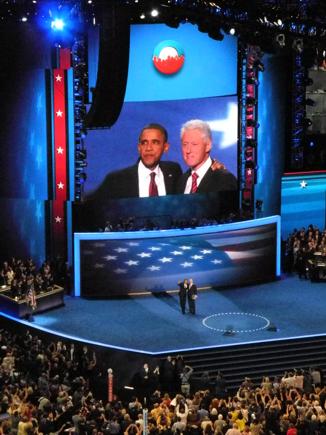
Last night, Former President Bill Clinton gave a speech to delegates that will be remembered for the ages, but for different reasons. It was a speech based on facts and logic. It was a speech which established protocols for how voters should think about the issues. It was also a tactical speech that counseled voters on how they should evaluate the Romney message which will be delivered not door-to-door but over the airwaves. It was Bill Clinton at his best; he didn’t just speak — he taught.

For those seeking to make an argument in an era of hyperbole, the Clinton speech — indeed perhaps a closing argument — is a lesson in how to organize facts and raise questions. It is a lesson for whistleblowers – a lesson for those who are sometimes caught up by emotion and argue passion rather than logic.

It’s all about Ohio

CHARLOTTE, NC — Inside the Democratic National Convention here it is all about winning voters in the State of Ohio. Democratic strategists now believe that if President Obama does not carry the State of Florida, Ohio is a must-win state. While Democratic leaders are guardedly optimistic about Obama’s chances in this rust belt state, they are taking no chances.

While the focus of the presidential race has been on healthcare, the Obama people refocused the debate last night beginning with a speech by former Ohio Governor Ted Strickland who reminded the packed house at Charlotte’s Time Warner Center that a billion dollar bailout by the Obama administration saved the US auto industry. The Democrats only hope that the Republicans challenge them on the wisdom of the bailout as the return of General Motors as a viable entity and the saving of thousands of US jobs is evidence that the bailout was a success. Democrats here believe this is a debate they will win.

Though the bailout meant job preservation, only once during the entire evening was the word “union” mentioned. That reference came during a speech by Massachusetts Governor Deval Patrick. There is a diminished union presence at this convention which sets it apart from those in Denver and Boston.

Tonight Bill Clinton takes the podium in day three.

Democratic Convention Update

Reuben Guttman at Democratic National ConventionCHARLOTTE, NC — Inside the Democratic National Convention, the Obama campaign finally picked a mid-west issue that may make a difference in the presidential election campaign. Starting with former Ohio Governor, Ted Strickland, a parade of speakers hammered on the auto industry rescue as a single accomplishment that will be hard for the Republicans to challenge as unsuccessful.

With the Republicans attacking Obamacare, Democrats needed to find something that was an undisputed success. With the Ohio vote in the balance, the auto industry rescue was made a focal point of day one at the Democratic convention. To make the point, the convention planners called upon former Ohio Governor Strickland; although he lost his bid for re-election, he is beloved in Ohio where he also served as a Congressman.

Finding undisputed success stories was the key to day one as Massachusetts Governor Deval Patrick reminded delegates of the end of the Iraq war and the elimination of Bin Laden as accomplishments of the current administration.

It was indeed a well choreographed event with the swing state delegations seated in front of the cameras. The states not up for grabs, including California, were seated to the rear of the convention, behind the battery of cameras that were directly in front of the stage.

1 34 35 36 37 38 63